

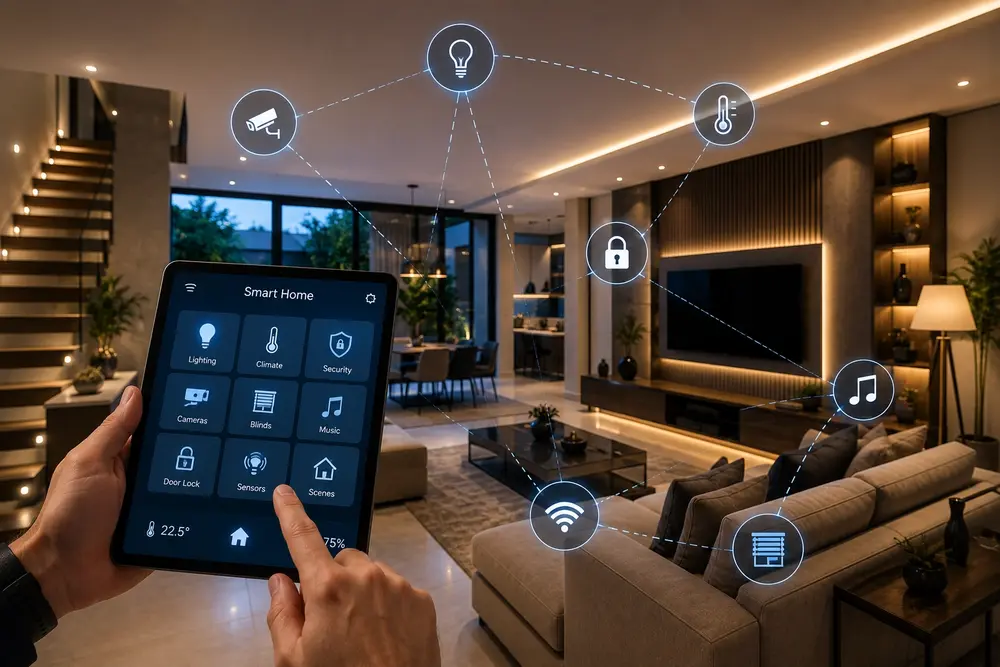

Smart home technology is no longer a niche interest for early adopters — it has become a standard consideration for anyone building or renovating a home in the UAE. As more devices, platforms, and installers enter the market, the technology itself keeps shifting toward simpler setup, better integration, and features that actually save time and money rather than just adding convenience for its own sake. Anyone currently exploring smart homes automation options for a new project should understand where the market is heading in 2026, since the systems installed today will need to work well with whatever comes next. Here are the trends shaping smart homes automation this year.

Matter Is Making Systems Work Together
For years, one of the biggest frustrations with smart homes automation was that devices from different brands often could not talk to each other properly, forcing households into a single ecosystem. The Matter connectivity standard has changed that by giving manufacturers a shared language that lights, locks, sensors, and hubs can all use regardless of brand. In 2026, more UAE suppliers are stocking Matter-compatible devices, which means homeowners have far more freedom to mix and match products without worrying about compatibility down the line.
AI-Driven Automation Instead of Fixed Schedules
Early smart homes automation systems relied heavily on fixed schedules — lights on at 6pm, air conditioning off at 9am. The newer generation of systems increasingly uses actual usage patterns and sensor data to adjust automatically, learning when a household typically wakes up, leaves for work, or comes home, and adjusting lighting, temperature, and security accordingly without needing constant manual reprogramming. This shift toward adaptive automation is one of the clearest trends in how smart homes automation is being marketed and installed this year.
Energy Monitoring Becomes a Standard Feature
With electricity costs a growing concern for many UAE households, energy monitoring has moved from an optional add-on to a expected feature in new smart homes automation packages. Systems now commonly show which rooms, appliances, or circuits are consuming the most power, and pair that visibility with automated rules that cut consumption during peak hours or when rooms are unoccupied.
Security and Automation Are Merging
Rather than treating security cameras, door locks, and lighting as separate systems, more installations in 2026 are unifying them into a single automation layer. A door sensor triggering an alert can automatically turn on relevant lights and start recording on nearby cameras, while a smart lock unlocking can disable the alarm zone for that entry point. This kind of cross-system automation used to require custom programming; it is increasingly available out of the box.
Voice Control, Easier Retrofits, and Better Apps
Voice assistant integration continues to improve in both accuracy and the range of commands supported, while companion apps are becoming easier for non-technical household members to use. A few practical improvements worth watching for this year include faster response times for voice commands over local networks rather than routing through the cloud, simplified guest access that does not require sharing a main account login, and better multi-language support, relevant for the UAE’s diverse resident population.
This trend matters for existing properties, not just new builds, because retrofitting has also become far easier. Earlier smart homes automation projects often required rewiring or dedicated cabling, which made older villas and apartments expensive and disruptive to upgrade. Battery-powered sensors, wireless switches, and hubs that work over existing Wi-Fi networks have reduced that barrier considerably, so a mid-renovation or fully lived-in home can now be automated in stages without major building work.
What This Means for New Installations
For anyone planning a new smart homes automation project in 2026, the practical takeaway is to prioritize open standards like Matter, choose a system with genuine automation rather than only scheduling, and ask suppliers directly about energy monitoring and cross-system integration before committing to a platform. It is also worth asking how easily the system can be expanded later, since most households add devices gradually rather than automating every room on day one. Systems built around these trends will stay useful and expandable for years, rather than needing a full replacement as the market moves forward.

Conclusion
Smart homes automation in 2026 is defined less by flashy individual gadgets and more by how well an entire system works together — across brands, across functions, and increasingly through automation that adapts to how a household actually lives. Homeowners exploring smart homes automation this year are in a good position to build a system that will keep pace with where the technology is going, provided they choose products and installers that understand these shifts rather than simply selling yesterday’s setup.


