

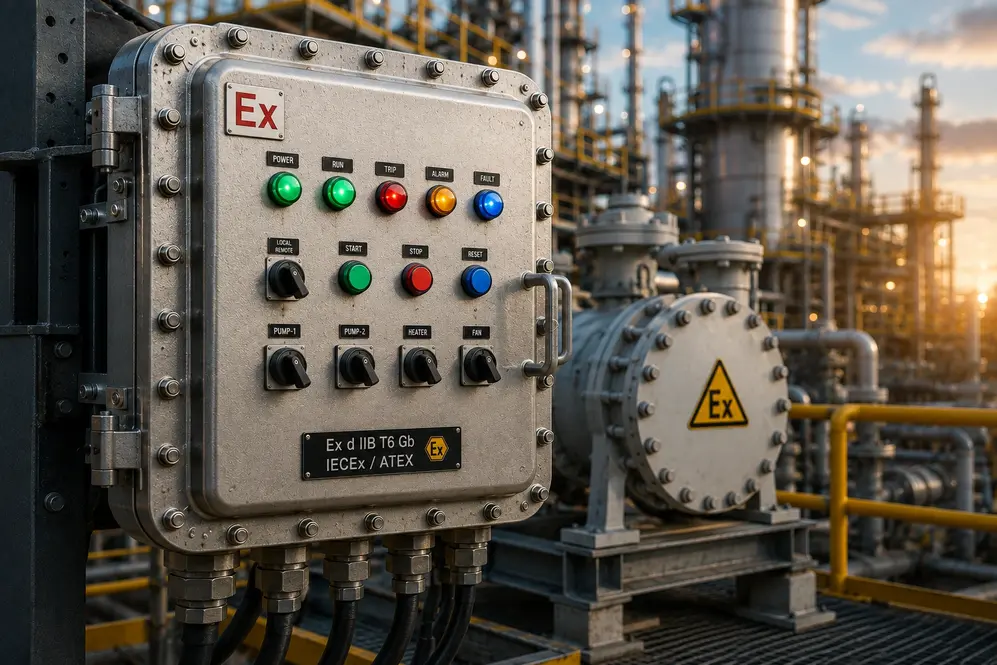

Control panels sit at the centre of almost every industrial electrical system, managing motors, switching, monitoring, and protection functions for the equipment connected to them. In facilities where flammable gases, vapours, or combustible dust may be present, a standard control panel is not an option — any panel installed in these areas must be built and certified to prevent it from becoming an ignition source. Specifying explosion proof control panels correctly requires understanding what actually separates a genuinely compliant panel from one that merely looks similar. This guide covers the key features that matter most when evaluating explosion proof control panels for a hazardous area project.

Certified Enclosure Construction
The starting point for any explosion proof control panel is its enclosure. These are typically built from cast aluminium, cast iron, or stainless steel, with wall thicknesses and joint tolerances engineered specifically to contain any internal ignition and prevent it from reaching the surrounding atmosphere. The precision of the flamepath — the narrow gap where the enclosure cover meets the body — is one of the most critical details in the entire design, since even small deviations from the certified tolerance can compromise the protection, the enclosure is supposed to provide.
ATEX and IECEx Certification
Just as with explosion proof lighting, control panels intended for hazardous areas must carry valid ATEX or IECEx certification from an accredited testing body. This certification should specify the exact zone classification, gas group, and temperature class the panel is rated for, and this must match the classification of the area where it will actually be installed. Buyers should always ask suppliers for the certificate itself rather than relying on general claims of compliance, and should check that the certificate covers the specific panel configuration being ordered, not just a generic product family.
Internal Component Layout and Access
A well-designed explosion proof control panel gives careful thought to how components are arranged inside the enclosure, not just the enclosure itself. Terminals, breakers, and control devices need to be laid out so that routine maintenance and inspection can be carried out safely and efficiently, without unnecessary disassembly. Panels that require excessive dismantling to reach basic components increase both maintenance time and the risk of the enclosure being reassembled incorrectly, which can compromise its protection rating.
Cable Entry and Sealing
Every cable entering an explosion proof control panel represents a potential weak point if it is not sealed correctly. Certified cable glands, properly rated for the panel’s zone classification, are essential at every entry point, and unused entries must be fitted with certified blanking plugs rather than left open or sealed with non-rated materials. This is one of the most common areas where poorly specified installations fail inspection, so it deserves particular attention during both design and commissioning.
Thermal Management and Environmental Resistance
Control panels generate heat internally from switching components, transformers, and wiring, and this heat must be managed so that external surface temperatures never exceed the ignition temperature of the atmosphere the panel operates in. Explosion proof control panels achieve this through a combination of enclosure mass, ventilation design where permitted, and component selection that limits internal heat generation in the first place — including, increasingly, LED indicator and instrumentation components in place of older, hotter technologies. Hazardous industrial sites are frequently also harsh environments, with exposure to moisture, chemicals, and temperature extremes, so these panels typically add corrosion-resistant coatings, marine-grade or stainless hardware, and IP66 or higher ingress protection ratings, ensuring correct performance over years of service rather than degrading after the first difficult season.
Commissioning and Documentation
A correctly built explosion proof control panel still needs to be commissioned and documented properly to remain compliant over its working life. This includes verifying that every cable entry, blanking plug, and enclosure joint has been assembled to the manufacturer’s torque and sealing specifications, and keeping a complete record of the panel’s certification, configuration, and any modifications made after installation. Facilities that keep this documentation organized find inspections and audits considerably easier, and it also protects against costly rework if a panel is ever relocated or expanded.

Conclusion
Selecting explosion proof control panels correctly is a technical decision with real safety consequences, and it deserves more attention than simply comparing price sheets. Enclosure construction, verified certification, sensible internal layout, correctly rated cable entries, thermal management, and environmental resistance together determine whether a panel will perform reliably for the life of the installation. Working with a supplier who understands hazardous area classification and can support the full specification process helps ensure explosion proof control panels are matched correctly to the facility they are protecting.


