

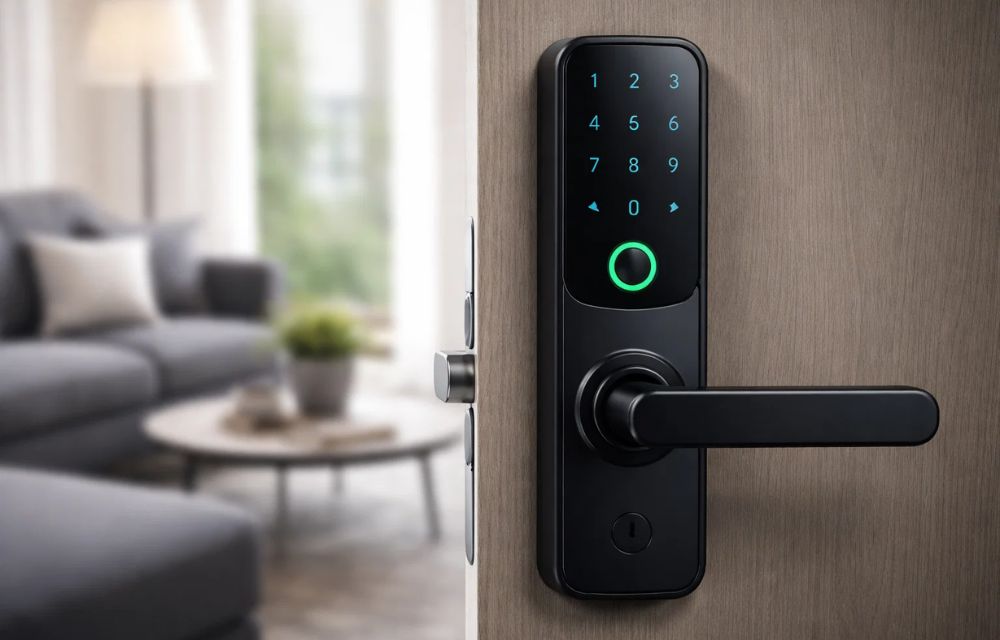

In the world of convenience and safety, the next step to the advanced is upgrading to a smart door lock that can be considered one of the most appropriate choices that you can make regarding your house or enterprise. The smart door locks are more than just the traditional mechanical locks, as they offer superior access control, remote monitoring, and ease of integration with smart home systems, in addition to improved security and user experience. This blog will take you through the different kinds of smart door lock mechanisms, and you will know how they operate as well as which one may be the best fit for your needs. Another fact worth considering is that Prolux International is one of the leading service providers of explosion protection solutions, electricals, light-emitting diodes, and solar integration, which will facilitate the contemporary infrastructure with innovative and trusted technologies.

1. Bluetooth Smart Lock Mechanisms
One of the most popular mechanisms nowadays is the smart lock that uses Bluetooth. These are locks that operate under Bluetooth Low Energy (BLE), which is a short-range wireless communication protocol with authorized devices like smartphones. After pairing, they can automatically recognize your device within range and unlock it; there is no physical key needed.
Key Features:
- A mobile application allows simple installation and setup.
- Proximity-based automatic unlocking.
- Low power consumption
Best: Residential doorways and apartments where convenience and comfort are the key factors.
Bluetooth locks are the locks customers prefer being able to use without necessarily having to have an active internet connection to unlock their keyless locks.
2. Wi-Fi Smart Lock Mechanisms
The Wi-Fi smart locks are directly integrated with your home or office network, which allows them to be used remotely anywhere on the globe. With a special app, it is possible to lock or unlock the door, track the activity, and even get notifications in real time.
Key Features:
- Accessibility at any point.
- Live notification and activity history.
- Support of speech recognition and home automation.
Best: Homeowners and business owners who desire complete remote control and monitoring options.
They come in handy, especially when the property is rented out, or the office and the access control must be controlled remotely.
3. Keypad and PIN-Based Mechanisms
Smart locks are keypads that enable users to open doors with the help of a secure PIN code. There are numerous models, which have several codes, e.g., temporary or time-based codes of guests, service providers, or employees.
Key Features:
- The customizable PIN codes and keyless entry.
- Visitor access codes are temporary.
- Eliminates the use of physical keys.
Best Use: Offices, shared accommodation, and rental property.
PIN-based doors are the easiest but very practical locks, and they are mostly used when there is more than one user of the doors.
4. Biometric Smart Lock Mechanisms
Biometric smart locks are locks that promote unique biological characteristics, most of which are fingerprints, to identify users. The more advanced systems can also have facial recognition or a palm scan. This mechanism is more secure since the biometric data is unique to a particular individual.
Key Features:
- Quick and reliable fingerprint identifications.
- Hardly replicable or crackable.
- Frequently used with the control of mobile apps.
Most Suited: Homes with high security needs, executive office, and commercial premises.
Biometrics ensure there is a balance between high security and the convenience of use, and as a result, biometrics are increasingly common in contemporary assets.
5. RFID and NFC Smart Lock Mechanisms
Smart locks can be unlocked with the help of RFID (Radio Frequency Identification) and NFC (Near Field Communication) smart locks by means of access cards, key fobs, or smartphones that have NFC. Such locks are based on short-range wireless communication, which provides fast and convenient access.
Key Features:
- Contactless access
- Fast authentication
- An access management system can be integrated.
Best Suited: Corporate buildings, hotels, and apartment complexes.
These processes are common in business settings where access and effective entry are required to be controlled.
6. Proximity-Based Smart Locks
Smart locks can be opened automatically because an authorised device is within range. These systems are hands-free in the use of technologies such as Bluetooth or ultra-wideband.
Key Features:
- Unlock yourself as you pass by.
- Seamless user experience
- Nokia can be combined with smartphones or wearables.
Best In: Automated smart homes.
The gadget does away with the manual process of unlocking doors, hence it is very convenient in day-to-day usage.
7. Hybrid Mechanical and Smart Mechanisms
A lot of smart locks are an integration of conventional mechanical deadlocks and digital access control. These hybrid models are such that even in the event of the breakdown of the electronic components, the door may still be of use by using a key to open the door.
Key Features:
- Reliability through a mechanical backup.
- Enhanced physical strength
- A combination of digital and traditional security.
Ideal Uses: Main doors that need enhanced technology, as well as reliable physical security.
Hybrid locks should be preferred by those who are interested in gaining the advantages of a smart lock but need the security of a normal key.
Choosing the Right Smart Door Lock
A choice of the appropriate mechanism is contingent on a number of factors:
- Security Needs: Biometric and hybrid systems offer a greater level of protection.
- Convenience Preferences: Proximity and Bluetooth locks are hands-free.
- Remote Access Requirements: Wi-Fi locks are the best when it comes to remote monitoring and control.
- User Volume: Keypad and RFID applications are efficient with multiple user properties.
When selecting a solution, compatibility with the current systems of a smart home, power backup possibilities, and durability should be considered.

Conclusion
Knowing the various kinds of mechanisms that are offered will enable you to make a sound choice to invest in an intelligent door lock. Ever since the days of Bluetooth and Wi-Fi connections, biometric authentication, and different mechanical mechanisms, each of them presents unique benefits depending on the requirements. Be it the remote access, the high level of security, or the regular convenience you seek, there is an intellectual solution that will address your needs. With technology still powering through the various industrial sectors, firms such as Prolux International, which is a major provider of explosion-proof systems, electrical products, LED lighting, and solar integration, are a good example of how modern advancements are transforming the way the world views safety, efficiency, and infrastructure.


